
Square CBD Shutdown: What Hemp and CBD Merchants Need to Do Now
Square has notified impacted sellers that it will no longer allow sales of CBD, hemp, and hemp-derived products on its platform, both online and offline. Marijuana Moment posted a notice to merchants, urging them to pull affected products by October 15, 2026, but to keep selling non-CBD products. Individually, some CBD-heavy sellers have been publicly alerted that they will no longer be able to sell and receive funds on their Square accounts as of November 5, 2026, which is not a universal rule for Square. If Congress does not act, that federal definition is set to be revised November 12, 2026.
The “Square CBD shutdown” does not mean every Square merchant account will automatically close on October 15, and it does not mean every CBD product is already federally illegal. It does mean that CBD and hemp retailers need to look closely at the exact notice that Square sent to them, keep their records, evaluate every single SKU and look at their Point of Sale and payment options now.
What did Square say about sales of CBD and hemp?
As per the report published by Marijuana Moment, CBD and hemp-derived items will no longer be permitted on the platform, Square informed an impacted merchant.
The reproduced notice says:
- By October 15, 2026, CBD, hemp, and anything produced from hemp must be taken out of the merchant’s Square catalog.
- The restriction applies to both in-person and online sales.
- The merchant may continue using Square for permitted non-CBD products.
- An outstanding Square Loan balance and its terms are not changed by the product-policy update.
Square told Marijuana Moment that it is notifying affected sellers because of new federal restrictions scheduled to take effect later in 2026. The company did not commit to reversing its policy if Congress delays or changes the federal law.
Separately, some CBD-primary sellers have publicly shared a different email stating that their full Square accounts will close on November 5, 2026. This is merchant-reported information, not a public Square announcement, and it was not the notice reproduced by Marijuana Moment.
Merchants should therefore follow the instructions in their own Square email. A store whose catalog is mostly CBD or hemp may receive different account-specific directions from a mixed retailer that can continue selling other products.
Why do older search results say Square allows CBD?
Square previously marketed a dedicated CBD program, so older help pages and third-party guides may still say approved merchants can use Square for qualifying hemp-derived CBD. Those results reflect the earlier program, not the newer merchant notice. Square’s former CBD industry page had been removed or redirected when this article was updated.
Use the most recent instructions Square sent to your account. Do not rely on an older search snippet or a guide written before the August 2026 policy communication.
The key dates merchants need to understand

- August 7, 2026 — The Square notice and company confirmation were publicly reported.
- October 15, 2026 — Deadline in the published Square notice to remove CBD, hemp, and hemp-derived catalog items from in-person and online sales.
- November 5, 2026 — Full-account closure date reported by some CBD-primary sellers; not publicly confirmed by Square as a universal deadline.
- November 12, 2026 — Current effective date for the federal hemp-definition change in Public Law 119-37, unless Congress changes it.
- The October 15 and merchant-reported November 5 dates are Square account or platform deadlines. The November 12 date is a federal statutory deadline. Treat them separately, and use the instructions Square sent to your business.
Is Square shutting down every CBD merchant account?
Not according to the mixed-catalog notice published by Marijuana Moment. That notice says the Square account may remain open and the business may continue selling permitted non-CBD products after it removes the affected items. In other words, Square is ending support for those product sales; it is not announcing a universal closure of every mixed retailer’s entire account on October 15. Some CBD-primary sellers, however, have reported receiving separate full-account closure instructions.
Your individual notice controls. If CBD or hemp represents most or all of your catalog, ask Square to confirm in writing:
- Your final processing date
- Whether your entire account or only certain catalog items are affected
- What happens to scheduled transfers, refunds, disputes, subscriptions, gift cards, and stored customer payment methods
- What records will remain available after the deadline
- How any Square Loan repayment will work for your specific account
Do not assume another merchant's email contains the same dates or instructions as yours.
Why is Square changing its CBD policy?
The current federal definition of hemp came from the 2018 Farm Bill. In general terms, it separated hemp from marijuana using a limit of no more than 0.3 percent delta-9 THC on a dry-weight basis. In November 2025, Congress enacted H.R. 5371 as Public Law 119-37. Section 781 changes that framework one year after enactment. Among other changes, the law:
- Moves from a delta-9-only measure to a broader total THC standard that includes THCA
- Excludes certain cannabinoids that are synthesized or manufactured outside the plant
- Excludes final hemp-derived cannabinoid products containing more than 0.4 milligrams of combined total THC and similar-effect cannabinoids per container
- Preserves a separate definition for specified industrial-hemp uses
The Congressional Research Service explains that products excluded from the new hemp definition may instead be treated as marijuana under federal controlled-substances law. That is why the change could affect many products currently sold as lawful hemp — even products that complied with the earlier delta-9 percentage test.
The law required the FDA to publish federal cannabinoid lists and additional guidance about the meaning of “container” within 90 days. As of this August 7 update, FDA had not published those materials. That uncertainty is another reason not to make a label-level decision without current documentation and qualified advice.
Does the new federal law ban all CBD?
No single label-level answer is safe for every product. The law does not simply state that every CBD product is prohibited. It changes the definition of hemp and adds composition, manufacturing, total-THC, and per-container limits that may exclude a broad range of current products. A product’s legal status can depend on:
- Its exact cannabinoid profile
- Whether any cannabinoid was synthesized or manufactured outside the plant
- Total THC, including THCA
- The amount present in the entire retail container
- Product form and intended use
- Federal Food and Drug Administration requirements
- State and local law
Square’s announced platform policy appears broader than this product-by-product federal analysis because Square says CBD and hemp-derived items will no longer be permitted on its platform.
Do not rely only on a front label, an old COA, or a supplier’s general “Farm Bill compliant” statement. Review the current batch documentation and obtain advice from qualified counsel for the jurisdictions where you sell.
What should merchants do after receiving a Square CBD notice?
1. Save the exact notice. Download or preserve the email, attachments, and any related support conversations.
Record every deadline and identify whether Square is restricting specific products or giving instructions about the whole account.
Record every deadline and identify whether Square is restricting specific products or giving instructions about the whole account.
2. Export the data needed to run the business. Do not wait until the final week. Export product catalog and SKUs, categories, modifiers, prices, and taxes, inventory counts by location, sales and payout reports, customer and loyalty data, gift-card or store-credit balances, employee roles and permissions, and online-order and fulfillment settings. Keep the export in a secure location and verify that it opens correctly.
3. Build a product-eligibility matrix. Create one row for every CBD or hemp SKU. Track product name, category and form, supplier and lot number, current COA, cannabinoid profile, total THC per container, states and sales channels where offered, current processor approval status, and action owner and decision deadline. This turns a vague problem into a list your legal, compliance, and payment partners can review.
4. Separate the POS decision from the payment-processing decision. A POS stores products, manages inventory, and runs checkout workflows. A payment processor, acquiring bank, and gateway determine whether a card transaction can be accepted. Before switching, ask who is underwriting the merchant account and whether the written approval covers your exact products, states, and channels.
5. Verify a prospective provider in writing. "CBD-friendly" is not enough. Ask: Which of my exact SKUs are eligible today? Does approval cover in-store, online, pickup, and delivery sales? Which states are excluded? What COAs, labels, supplier invoices, and policies are required? Are reserves, payout delays, or early-termination fees possible? Never disguise CBD or hemp products under generic names or an inaccurate merchant category — misrepresentation can create a second shutdown and make future underwriting harder.
6. Plan and test the migration. Map the catalog, taxes, inventory, employees, loyalty balances, receipts, hardware, online ordering, and accounting workflows. Test a normal in-store sale, a refund and void, an online order, ID prompts and age restrictions, inventory deduction and cross-channel synchronization, end-of-day closeout, and payout visibility. Keep a written cutover checklist and assign an owner to each task.
7. Prepare for more than one outcome. Congress is considering a short delay and other proposals that could change the November 12 federal effective date. As of this article’s August 7 update, no delay has been enacted. Merchants should plan around the law currently on the books until a bill passes both chambers and is signed.
A federal delay would not automatically require Square to reverse its own platform policy. Likewise, a new payment provider cannot authorize the sale of a product that is unlawful in the relevant jurisdiction.
A federal delay would not automatically require Square to reverse its own platform policy. Likewise, a new payment provider cannot authorize the sale of a product that is unlawful in the relevant jurisdiction.
How to evaluate a Square alternative for a CBD or hemp store
The right alternative should fit both your current product mix and the operational reality of regulated retail. Look for:
- Underwriting designed for high-risk or age-restricted retail
- Written product and channel approval
- Fast, accurate bulk inventory migration
- Product categories, batch or lot details, and COA access
- Configurable age prompts and ID-scanning workflows
- Unified in-store and online inventory
- Pickup and delivery controls
- Multi-location reporting and employee permissions
- Clear processing costs, reserves, payout timing, and support escalation
- A process for reviewing catalog changes before products are sold
No responsible provider should guarantee that every CBD, THCA, delta-8, or hemp-derived product will be eligible everywhere.
How Quickvee can help with a Square transition
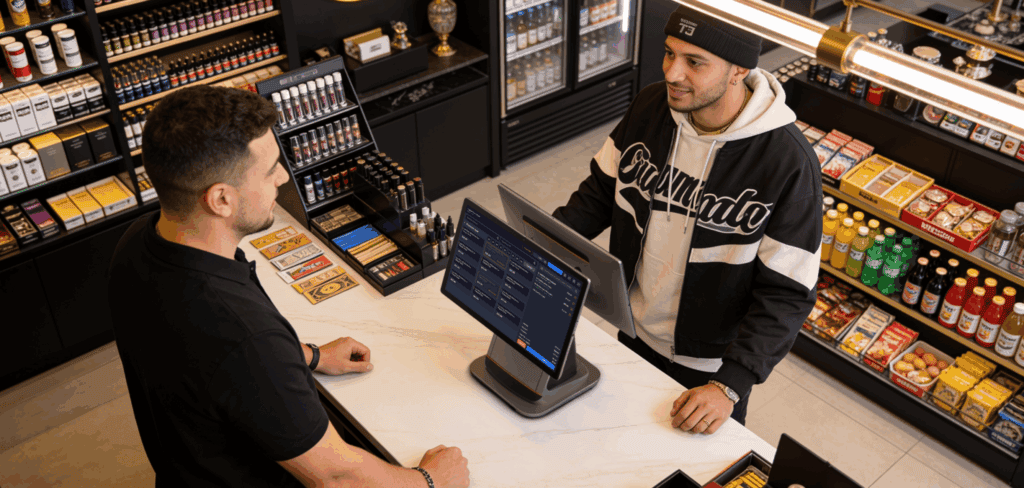
Quickvee POS is designed for CBD and age-restricted retail. Its tools include:
- Integrated payment processing designed for CBD and high-risk retail, subject to underwriting and eligibility
- CBD product attributes plus COA and lot-level tracking
- Configurable product restrictions, age prompts, and ID scanning
- Live inventory across in-store and online orders
- Pickup and delivery workflows
- Loyalty, coupons, reporting, employee permissions, and multi-location management
- Bulk inventory import and 24/7 support
Quickvee cannot make a prohibited product lawful, and approval is not automatic. What our team can do is review your store, product list, COAs, sales channels, and migration needs so you understand the path forward.
Bring your product list, current COAs, and Square inventory export. Book a free Quickvee demo or call 1-800-200-8202.
FAQs
1) Is Square banning CBD sales?
Square has told affected merchants that CBD, hemp, and hemp-derived products will no longer be permitted on its platform for online or in-person sales. The published notice gives an October 15, 2026 removal deadline.
2) Does Square still allow CBD sales in 2026?
Square previously offered a dedicated CBD program, which is why older pages and articles say it accepts qualifying CBD sales. The newer notices show those products will no longer be permitted. Follow the current instructions for your account, not an older search result.
3) Is Square closing CBD merchant accounts?
The published mixed-catalog notice says merchants may keep using Square for permitted non-CBD products after removing the affected items. Separately, some CBD-primary sellers have reported November 5 full-account closures. A merchant whose business is primarily CBD or hemp should follow its account-specific notice and ask Square to confirm the entire account timeline in writing.
4) Can I keep Square for non-CBD products?
The notice reproduced by Marijuana Moment says yes, to the extent those products and activities comply with Square's other policies. Confirm the treatment of your own account directly with Square.
5) Is CBD federally illegal after November 12, 2026?
Not every product can be answered with a blanket yes or no. Public Law 119-37 changes which products qualify as hemp by using total-THC, manufacturing, and per-container standards. Product composition and other federal, state, and local requirements matter.
6) What does the 0.4 mg THC-per-container rule mean?
The new federal definition excludes a final hemp-derived cannabinoid product if the combined amount of total THC and designated similar-effect cannabinoids is greater than 0.4 milligrams in the retail container. This is a per-container amount, not simply a percentage or per-serving limit.
7) Can another processor let me keep selling the same products?
Only if the exact products are lawful and the processor, acquiring bank, and other partners approve them. Switching providers does not override federal, state, or local law.
8) What should I bring to a POS or processing review?
Bring your complete product list, recent COAs matched to each batch, labels, supplier information, processing statements, monthly sales volume, average ticket, chargeback history, sales channels, states served, and a current Square catalog export.
9) What if Congress delays the federal hemp change?
Update your legal and product review when any new law is enacted, but do not assume a proposal has changed the current deadline. A federal delay also would not automatically reverse Square's platform decision.
10) Does Quickvee support CBD stores?
Quickvee is designed for CBD and age-restricted retail and offers integrated processing built for high-risk categories. Merchant and product acceptance remain subject to underwriting, bank-partner requirements, and applicable law.
Recent Blogs
Is THC Banned in 2026? State-by-State Guide for Retailers
August 24, 2026
Square CBD Shutdown: What Hemp and CBD Merchants Need to Do Now
August 11, 2026
Delta 8 vs Delta 9 vs THCA: 2026 Smoke Shop Guide
July 16, 2026
How to Increase Smoke Shop Sales with Online Ordering
June 10, 2026