POS System Cost by Business Size: Single Store vs. Multi-Location
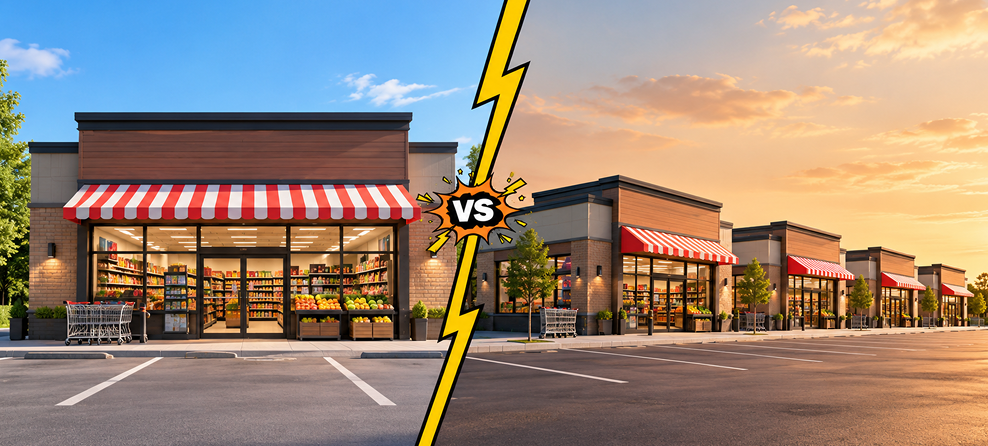
Single-location retailers typically pay $50 to $200 per month for POS software, plus a one-time hardware cost of $500 to $2,500. Multi-location businesses pay that base amount plus an additional $100 to $300 per month for each additional location, along with the hardware cost of outfitting each new store.

Beyond the number of stores, the real figure varies depending on the type of business, whether it’s a clothing boutique, a grocery store, a vape shop, and so on. Inventory complexity, hardware requirements, and payment processing risk all influence it in different ways.

This breakdown shows the cost of single-store and multi-location POS systems, how costs vary between retail types, and where the real differences in cost lie.

What Determines POS System Cost?

The cost of any POS system falls into three categories, and understanding each one individually is the only way to compare systems properly.

Software

Software. This is the recurring subscription fee for the platform: register, inventory management, reporting, compliance, and other tools. Software typically runs $50 to $200 per month for a standard single-location retail setup. Multi-store and enterprise tiers generally charge $100 to $300 per month for each additional location, or require custom pricing. Some business types, such as grocery and restaurants, fall outside the standard retail range, as covered below.

Hardware

Hardware. This is the upfront (or financed) expense of the physical equipment: terminals, barcode scanners, receipt printers, cash drawers, card readers, and more. Simple countertop displays cost $200 to $600 on their own, and full display installations can run $1,000 to $2,500 per screen. Specialized gear, such as scales or dedicated terminals for deli counters and produce sections, costs an additional $300 to $800. A complete single-store setup typically totals $500 to $2,500.

Payment processing

Payment processing. This is the ongoing per-transaction fee charged every time a customer pays by card. Rates vary by processor and by how "risky" your product category is considered. Product category risk matters far more than most new store owners realize, as explained below.
Single-Store POS System Cost: What to Expect

For a single-location business, POS system cost breaks down fairly predictably once you separate the three components above.

Software for a single location typically falls in the $50 to $200 per month range for a standard retail plan. Budget-focused systems can start closer to $0 to $29 per month with basic features, while plans with deeper inventory and reporting tools push toward the top of the range. Grocery and restaurant software can run above this range, as covered in the business-type sections below.

Hardware for a single-location store depends heavily on the counter setup. A minimal single-register setup (terminal, card reader, receipt printer, and cash drawer) usually totals $500 to $1,500. Adding a second checkout lane, a customer-facing display, or a handheld scanner raises that figure, with a full single-store setup reaching up to $2,500.

Payment processing for single stores usually runs on a flat-rate or interchange-plus model, with typical card-present rates of 2.6% to 3% or more, plus a small flat per-transaction fee for standard retail. This is where the type of business you run starts to matter a lot.

POS System Cost by Business Type (Single Store)

The honest answer to “How much does a POS system cost?” depends entirely on what you’re selling. Here’s how it plays out across common retail categories.

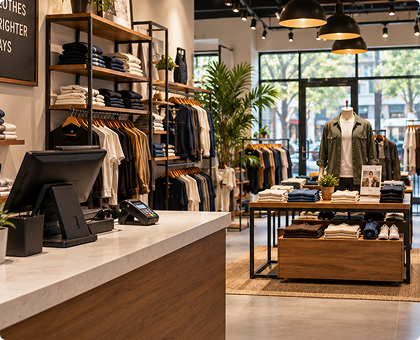
POS System Cost for a Clothing or Boutique Store

A clothing or boutique POS system is usually on the lower end of the cost spectrum. Clothing retail doesn’t require specialty hardware like scales or age-verification scanners, so most boutiques get by with a basic terminal, barcode scanner, and receipt printer, typically $500 to $1,200 in hardware, plus $50 to $100 per month in software fees. The main cost driver for apparel retailers is variant tracking (size, color, style), which is a software feature rather than a hardware one, so it rarely pushes the price much higher.

POS System Cost for a Grocery Store

Grocery POS costs run higher than general retail because of the hardware grocery requires: integrated weight scales for produce and bulk items (300–800 each), multiple checkout lanes, and often self-checkout kiosks if the store is large enough (2,000–5,000+ per kiosk). Software costs also tend to run higher, often $100 to $250 per month per lane, because grocery-specific software needs to handle perishable inventory, lot tracking, and high SKU counts that a typical retail POS isn’t built for. As a result, a grocery store’s hardware total typically runs $1,500 to $5,000 or more, above the standard single-store range.

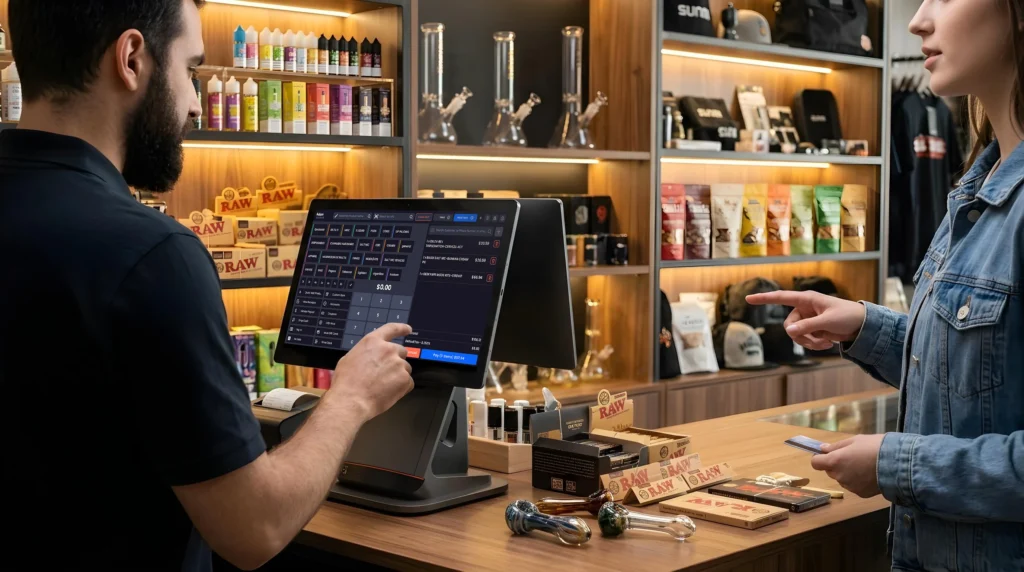
POS System Cost for a Vape or Smoke Shop

A vape or smoke shop POS system has a different cost structure from general retail, mainly because of two factors: age-verification compliance and payment processing risk. Age verification (ID scanning at checkout) is close to mandatory given legal requirements around tobacco and nicotine sales, and it’s typically either bundled into specialty POS software or billed as an add-on. Hardware costs stay in line with general retail, at $500 to $1,500, since the compliance cost shows up mostly in software or add-on fees rather than in equipment. Software pricing for smoke shop POS systems ranges widely, from $0 per month (with integrated payment processing) on purpose-built platforms up to $100 to $180 per month on general retail systems with compliance add-ons bolted on.

The bigger cost difference is payment processing. Tobacco, vape, and CBD are classified as “high-risk” by most payment processors, which means smoke shops using a generic POS system often pay noticeably higher processing rates, sometimes 3.5% to 4% or more per transaction, or get their merchant account frozen entirely. POS systems built specifically for age-restricted retail typically include high-risk-friendly payment processing as part of the package, which can offset the cost of the software.

POS System Cost for a Convenience Store

Convenience stores sit between general retail and grocery. Software typically runs $59 to $150 per month and hardware $800 to $2,000. The main cost drivers are lottery and fuel integrations and a high SKU count, which call for a POS built to handle fast-moving inventory.

POS System Cost for Restaurants and Quick-Service Businesses

Restaurant POS costs are among the highest of any retail category, since table management, kitchen display systems, and split-check functionality add both software and hardware cost. Full-service restaurant software commonly runs $100 to 300 per month per terminal, with hardware costs pushed up by kitchen display screens (1,000 to $2,500 each) and handheld tableside ordering devices. Total restaurant hardware typically runs $1,500 to $4,000 or more.

Quick Reference: Single-Store Cost by Business Type

Business type Typical monthly software cost Typical hardware cost Notable cost driver
Clothing/boutique $50–$100 $500–$1,200 Variant tracking
Grocery store $100–$250 per lane $1,500–$5,000+ Scales, kiosks, perishable inventory
Vape/smoke shop $0–$180 $500–$1,500 Age verification, high-risk processing
Convenience store $59–$150 $800–$2,000 Lottery, fuel integration, high SKU count
Restaurant $100–$300 per terminal $1,500–$4,000+ Kitchen displays, table management

These ranges are general industry patterns rather than quotes from any single provider, and actual pricing will vary by vendor and by what's bundled into a given plan.


Multi-Location POS System Cost: What Changes

Moving from one store to several doesn't just multiply your single-store cost. It usually changes the pricing structure entirely.

Per-location software fees

Per-location software fees are the most common model. Most providers charge $100 to $300 per month for each additional location on top of the base plan, rather than charging each store as if it were a standalone account. Some providers instead move multi-location businesses to a flat enterprise rate once they cross a certain number of stores.

Centralized inventory and reporting

Centralized inventory and reporting, the ability to see stock and sales across every location from one dashboard, is often gated behind a higher software tier for multi-location accounts. This is usually where the real jump in POS system cost happens: a feature that's included by default for a single store often becomes a paid upgrade once centralized, cross-store data is involved.

Hardware costs

Hardware costs scale linearly with each new location, since each store needs its own terminal, scanner, and printer setup. There's rarely a multi-location discount on hardware itself, though some vendors offer bundle pricing for bulk orders when opening several stores at once.

Additional checkout lanes

Additional checkout lanes within a single location typically add $50 to $250 per month each, separate from the per-location fee. This matters more for grocery stores and larger-format retailers than for boutiques or smoke shops.

Single Store vs. Multi-Location: Side-by-Side Cost Comparison

Cost component Single store 3-location business
Base software $50–$200/mo $50–$200/mo (base) + $100–$300/mo per additional location
Hardware (one-time) $500–$2,500 $1,500–$7,500 (three times the single-store hardware cost)
Centralized reporting Often included Often a paid upgrade
Processing fees Per-transaction, same rate structure Same rate structure, higher total volume
Typical first-year total* $1,100–$4,900 $4,500–$17,100

*First-year totals combine 12 months of software and one-time hardware. They exclude payment processing fees, centralized-reporting upgrades, and additional checkout lanes, which would raise the total.

The multi-location total varies widely depending on business type. A 3-location clothing boutique chain will land well below a 3-location grocery or restaurant operation, for the same hardware-cost reasons outlined above.

Why Vape Shops and Smoke Shops Pay More on Generic POS Systems

Age-restricted retail (vape shops, smoke shops, tobacco retailers, and CBD stores) tends to carry a different POS cost profile than almost any other retail category, multi-location or not. The driver isn’t the POS software itself. Generic payment processors treat these categories as high-risk, which shows up as higher processing rates, reserve requirements, or outright account denial.

This is why many smoke shop owners end up paying more in the long run on a cheap, generic POS system than they would on a system built specifically for age-restricted retail. The sticker price on the software is lower, but the processing fees and compliance workarounds (manual ID checks, bolted-on verification apps) add real costs that don’t show up on the pricing page.

How to Keep Multi-Location POS Costs Under Control

A few practical ways multi-location retailers keep their total POS system cost predictable:

Negotiate pricing

Negotiate per-location pricing upfront rather than accepting list price once you've already signed on for store one. Most providers have room to move on per-location fees for committed multi-store accounts.

Standardize hardware

Standardize hardware across locations to avoid paying different per-unit rates for mismatched terminal models.

Centralized reporting

Check whether centralized reporting is included or an add-on before signing. This is the single most common place multi-location costs run higher than expected.

Payment processing rates

Ask directly about processing rates for your product category if you're in a high-risk retail segment, since this fee is often the largest hidden cost over a year of operation.

Frequently Asked Questions

A single-store POS system typically costs $50 to $200 per month in software fees, plus $500 to $2,500 in one-time hardware costs. Simpler retail, such as clothing or boutique stores, runs toward the lower end. Grocery stores and restaurants often exceed these ranges because of specialty hardware and per-lane or per-terminal software pricing.

Multi-location POS systems typically add $100 to $300 per month for each additional store, plus the hardware cost of outfitting each new location. Centralized, cross-store reporting is often a separate paid upgrade rather than included by default.

Vape and smoke shops are classified as high-risk by most payment processors, which raises per-transaction processing fees. POS systems built specifically for age-restricted retail typically include high-risk-friendly payment processing, which can offset that cost compared to bolting compliance tools onto a generic retail POS.

Yes. Grocery POS systems typically cost more due to specialty hardware like integrated scales and self-checkout kiosks, along with software built to handle perishable inventory and high SKU counts that general retail systems aren't designed for.

A $0 per month POS system usually means the software fee is waived in exchange for using the provider's integrated payment processing, so the provider's revenue comes from processing fees rather than a software subscription. It's worth confirming the processing rate directly, since that's where the real cost of a "free" POS system shows up.