
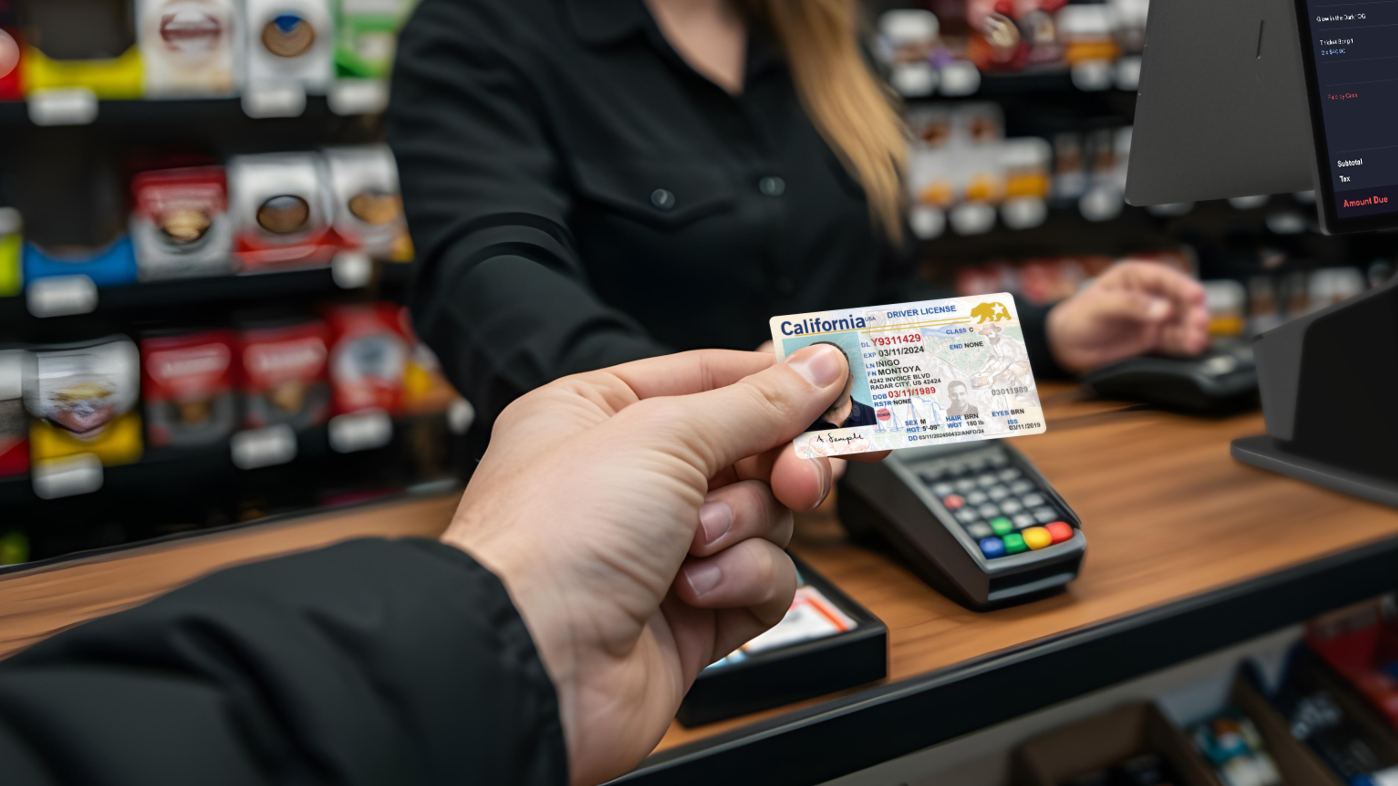
Age Verification for Smoke Shops: What the Law Requires and How to Stay Compliant
In the United States, smoke shops cannot sell tobacco products or e-cigarettes to anyone under 21. Every smoke shop owner must check the photo ID of anyone under 30 who is attempting to buy tobacco products. State and local laws may also impose stricter age-verification rules, including ID scanning.
Federal tobacco violations can lead to warning letters, escalating civil money penalties, and potentially no-tobacco-sale orders for repeat violations.
This guide covers what the law actually requires in 2026, what’s changed recently, what an inspector is going to look for if they walk into your store next week, and how to build a system that doesn’t depend on a tired cashier remembering at 11pm on a Friday.
Federal Tobacco 21: the baseline

Federal floor is tobacco 21. It must be fulfilled in all shops in all states. Anything harder is a state/local addition. Signed into law December 20, 2019, T21 raised the federal minimum age to purchase any tobacco product from 18 to 21. The term “tobacco product” is a very broad term under federal law. It covers:
- Cigarettes
- Cigars (including filtered little cigars)
- E-cigarettes, vape devices, vape pens, mods, and pods (collectively “ENDS” — Electronic Nicotine Delivery Systems)
- E-liquids and vape juice
- Hookah tobacco
- Smokeless tobacco (chew, snuff, dip)
- Nicotine pouches (Zyn, Velo, On!)
- Roll-your-own tobacco and cigarette papers
Three things about T21 that owners sometimes miss:
There's no military exemption. A 20-year-old active duty Marine cannot legally buy a vape from your store. The legislation is explicit on this.
No grandfathering. When T21 passed in December 2019, every customer who was previously legal at 18, 19, or 20 became illegal overnight. There's no "you were 19 when we sold to you before" exception.
Applies to every retail establishment. Whether it is tobacco shops, online sellers, or vending machines. Every retail transaction has to clear the same age bar.
What changed in 2024 and 2026
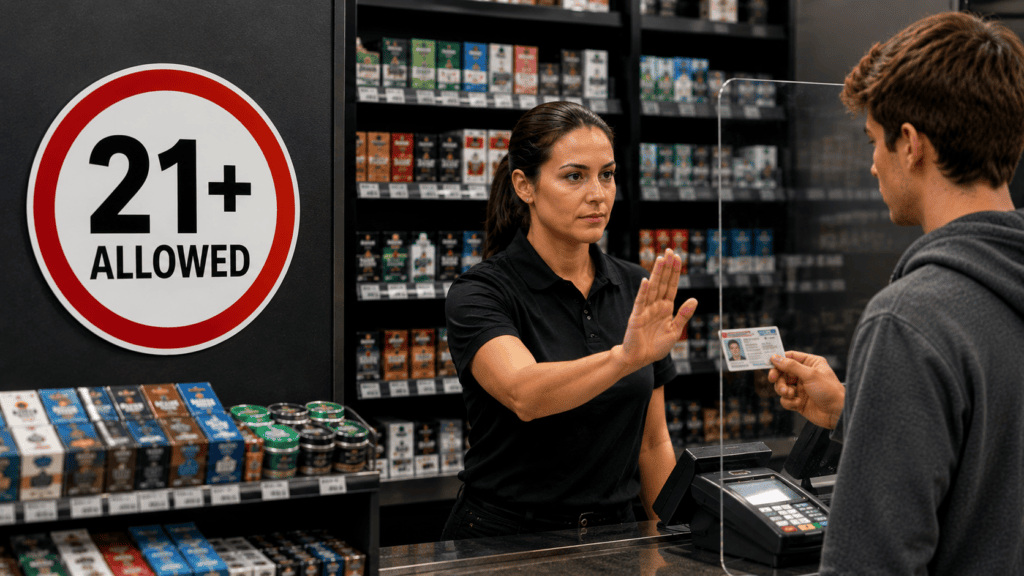
The federal government has put strict rules and regulations for selling tobacco related products, especially those who are under 21 years. Two changes landed that every shop owner needs to understand.
The under-30 photo ID requirement
Before September 30, 2024, federal guidance was that retailers had to check photo ID for anyone who appeared to be under 27. The final rule raised that threshold to under 30. Effective immediately at publication, you have to verify photo ID for any customer who looks like they could be under 30 buying any tobacco product.
“Looks like they could be under 30” is judgment-based, which is part of the problem. The defensive posture is simple: train every cashier to card every customer who looks under 30, and when in doubt, card. Most operationally tight shops just card everyone.
Vending machine restrictions tightened
The same final rule raised the vending machine restriction. Vending machines can only be operated where adults (21+) can go. The Federal government passed the rule to start using this standard from Jan 12, 2026. This is the single most common source of inadvertent violations — the machine was fine under the old rule and nobody updated the location protocol when the rule changed.
State laws stack on top of federal
Federal law is the floor, not the ceiling. States can and do impose additional requirements. A few patterns worth knowing:
Mandatory electronic ID scanning. Several states require retailers to use scanning technology or automated software to verify ID rather than just visual inspection. Nevada, for example, requires electronic scanning for any customer who appears to be under 40 (not 30). The fine for failing to use the scanning technology is separate from — and stacks on top of — the fine for an actual underage sale. If you're in a state with mandatory scanning, eyeballing a license isn't compliant even if the ID is real and the customer is 35. The scan itself is the legal requirement.
Flavored product bans and additional restrictions. California (December 2022) and Massachusetts (June 2020) have banned flavored tobacco products including menthol. Several other states have local bans. Your POS should be configured to prevent ringing up products that aren't legal to sell in your state.
License-revocation thresholds. Most states have progressive penalty structures. First violation: fine. Second violation within a defined window (often 36 months): higher fine and possible suspension. Third violation: license revocation. Once revoked, you typically cannot reapply for a tobacco retail license for several years. For shops where tobacco and ENDS drive most revenue, license revocation is functionally an existential event.
PACT Act: online and delivery sales
If you’re selling online or doing delivery, the Prevent All Cigarette Trafficking (PACT) Act adds a separate compliance layer on top of T21. PACT Act covers cigarettes, roll-your-own tobacco, cigarette and cigar wrappers, ENDS and ENDS components, and smokeless tobacco. It does two things:
First, it requires age verification at two distinct stages for any sale shipped to a consumer:
Pre-sale: Before accepting the order, the seller must verify the customer’s full name, date of birth, and residential address against a commercially available database. This is a database check — the customer typing “yes I’m 21” on a checkbox doesn’t count.
At delivery: The shipping method must obtain a signature from the original purchaser or another adult at the address who meets the legal purchase age, and that adult must show government-issued ID.
Second, the PACT Act requires sellers shipping across state lines to register with the ATF, register with each state they ship into, collect state tobacco excise taxes, and file monthly reports. Most of the big carriers (USPS, FedEx, UPS, DHL) have opted out of the consumer verification programme.
For most smoke shops in 2026, this means online sales realistically work for local delivery only. Local delivery through a service like Uber Direct still requires the dual verification (ID at digital checkout + ID confirmed at the door by the driver), but it’s a known, supported workflow.
What inspectors actually look for
Statutes describe what’s illegal. Inspections describe what’s actually enforced. Here’s what to expect.
The compliance check (secret shopper) buy
Both FDA and state agencies conduct routine compliance checks using underage buyers — typically 17- or 18-year-olds working with an inspector. The buyer attempts to purchase a tobacco product. If your cashier sells without asking for ID, you have failed the check. If the cashier asks for ID and the buyer hands over a valid ID showing they are under 21, the cashier should refuse to sell. Selling to that buyer also fails.
Compliance checks are unannounced. Your defense is that every transaction follows the same process every time, regardless of who’s at the counter.
The walkthrough
Inspectors who arrive in person are typically looking for several things beyond the secret shopper buy:
Is there visible signage about the 21+ minimum age?
Are tobacco products in a position where minors cannot self-serve?
Is the cashier trained on the carding policy?
Are vending machines, if any, in locations where minors under 21 are prohibited?
Are flavored products in states with flavor bans removed from inventory?
Are products that require state-specific licensing compliant with state product rules?
The records request
If your shop is selling online or doing delivery, inspectors may request your age verification logs. Manual logs (a notebook the cashier scribbles in) are usually inadequate. The defensible standard in 2026 is system-generated logs from your POS showing every age-restricted transaction, whether ID was verified, what type of ID was checked, and the cashier responsible. These logs need to be retained — two years is a common minimum.
Building a system that makes compliance automatic
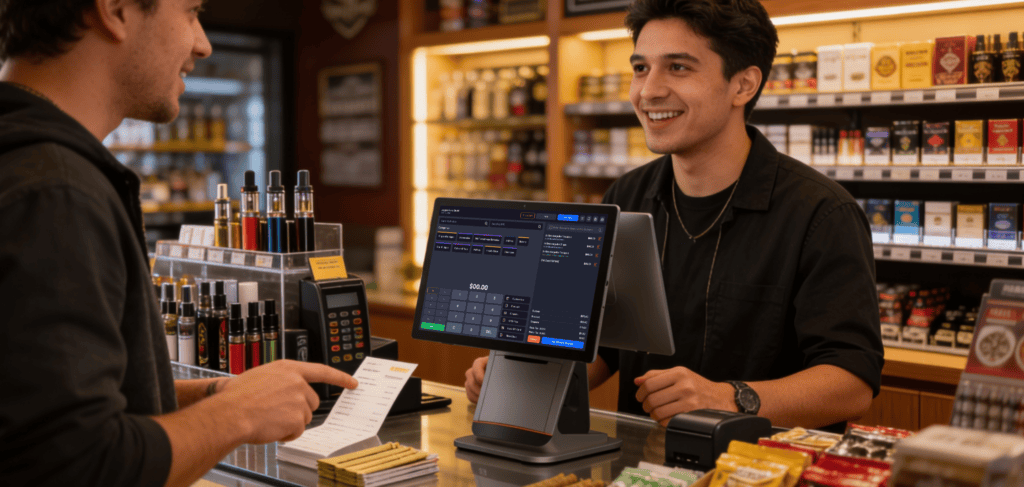
Compliance failures in smoke shops are almost never deliberate. They're the result of inconsistent process: the new cashier who wasn't trained yet, the experienced cashier who got busy and forgot, the customer who "looks 35" and didn't get carded. The fix isn't more training. It's removing the decision from the cashier entirely. That means a POS configured so that:
Age verification is mandatory at the SKU and category level. If any tobacco, vape, Kratom, Delta 8 or CBD is rung up, the ID scan or 21+ prompt will automatically appear before the transaction can proceed. You can't skip the step.
ID scanning is the default. Scan the driver's license or ID. The POS reads the date of birth and confirms 21+ automatically. No mental math at the counter, no chance of the cashier eyeballing wrong.
Every verification is logged. Date, time, register, cashier, product category, verification method. If an inspector asks for records, you produce them in minutes from the dashboard, not by digging through receipts.
Online orders have age verification at digital checkout. For shops doing online ordering, the platform requires the customer to upload a photo of their ID at checkout for age-restricted products. The order is tagged for in-person ID verification at pickup or delivery handoff. Your driver or counter staff verifies again before the order is released.
Category-level age gates beat SKU-level. Setting age verification on each individual product is how new SKUs slip through the gate. Set it at the category level ("Tobacco," "Vape," "Kratom," "Hemp") and any new product added to that category inherits the rule automatically.
Quickvee was built for age-restricted retail from the ground up rather than retrofitted from a generic POS. Mandatory ID prompts at every regulated transaction, automated 21+ verification from scanned IDs, full audit logs for state and federal inspection records, online checkout with ID upload and in-person handoff verification, and category-level age gates that handle every new SKU automatically — all of these come standard.
FAQs
No. Federal law makes no exception for military status or age. Once Tobacco 21 took effect, the purchase age became 21 for every customer, with no carve-outs based on service, employment, or prior purchase history.
Not anymore. As of the FDA's 2024 rule, retailers must check photo ID for anyone who could plausibly be under 30, not 27. Most compliance-focused shops now card everyone rather than relying on a visual guess.
It depends on your state. Some states — Nevada is a notable example — legally require electronic ID scanning, not just a visual check, for anyone who could be under 40. In those states, a valid-looking ID isn't sufficient on its own; the scan itself is the compliance requirement.
Yes. Online and delivery sales trigger the PACT Act, which requires age/identity verification against a database before the sale, plus a second in-person ID check at the point of delivery. A checkbox confirming "I'm 21" doesn't satisfy this requirement.
Most states use a progressive penalty structure. A first violation is typically a fine; repeated violations within a set window escalate to steeper fines, suspension, and eventually license revocation, after which reapplying isn't immediate.
It depends on whether ID was requested at all. Compliance checks test the process, not just the outcome — a cashier who skips the ID request fails the check regardless of what ID the buyer was carrying.
A handwritten log usually isn't considered sufficient anymore. The accepted standard is system-generated records showing the date, time, register, cashier, product category, and verification method for every age-restricted sale — typically retained for at least two years.
Recent Blogs
Is THC Banned in 2026? State-by-State Guide for Retailers
August 24, 2026
Square CBD Shutdown: What Hemp and CBD Merchants Need to Do Now
August 11, 2026
Delta 8 vs Delta 9 vs THCA: 2026 Smoke Shop Guide
July 16, 2026
How to Increase Smoke Shop Sales with Online Ordering
June 10, 2026