
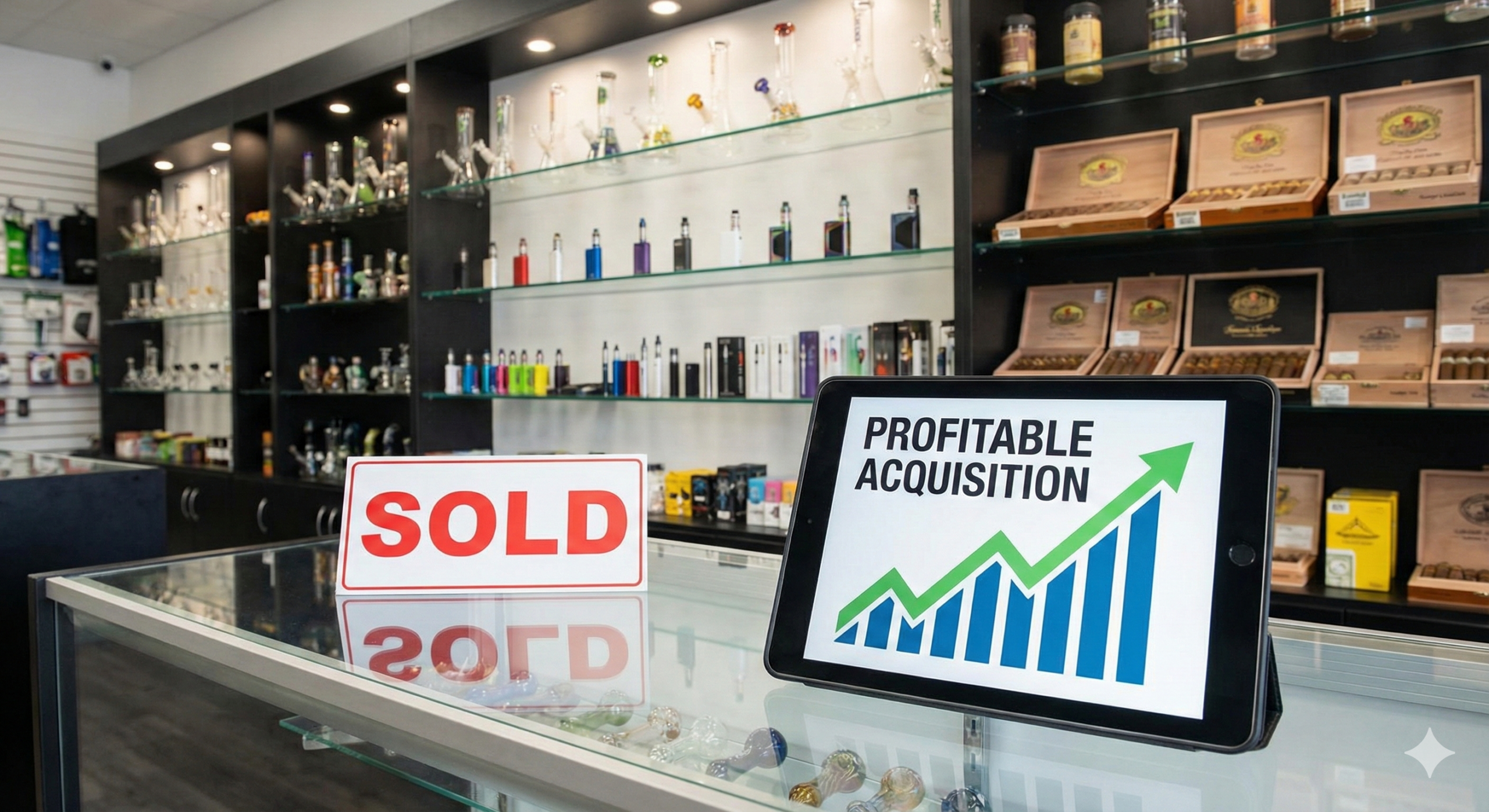
How to Buy a Profitable Smoke Shop: Complete Buyer's Guide (2026)
Last Updated: May 2026 | Reading Time: 9 minutes
If you’re looking to buy a profitable smoke shop, you’re entering one of retail’s most resilient niches. The U.S. smoke shop and tobacco retail market continues to grow — driven by demand for vaping devices, CBD products, and smoking accessories — making it an attractive acquisition target for first-time buyers and seasoned entrepreneurs alike.
But buying an existing smoke shop is not as simple as handing over a check and opening the doors. Done right, it gives you instant cash flow, an established customer base, and a proven operation. Done wrong, you inherit someone else’s compliance problems, slow-moving inventory, and a lease you can’t escape.
This guide walks you through everything — from how much a smoke shop costs to buy, to financing options, due diligence red flags, and the exact 8-week timeline to close your acquisition confidently.
Why Buy an Existing Smoke Shop Instead of Starting From Scratch?
Starting a smoke shop from zero means months of build-out, licensing delays, staff hiring, and brand-building before your first dollar of revenue. Buying an established, profitable smoke shop eliminates most of that risk.
Here’s what you gain from day one:
- Immediate cash flow — no waiting for sales to ramp up
- Existing customer loyalty — regulars who come in weekly
- Proven inventory mix — you know what sells in that location
- Established supplier relationships — often with negotiated pricing
- Licenses already in place — tobacco retail permits, local business licenses
- Trained staff — people who know the products and the customers
Modern smoke shops are far more diversified than they were a decade ago. Today’s profitable locations typically carry vaping devices, e-liquids, disposable vapes, premium cigars, CBD products, hemp accessories, hookahs, glass pipes, and rolling supplies. That product diversity is exactly what drives strong margins and repeat traffic.
How Much Does a Smoke Shop Cost to Buy?
One of the first questions every buyer asks is: what is a smoke shop worth?
Smoke shop acquisition prices vary significantly based on location, revenue, lease terms, and inventory size. Here are realistic price ranges you should expect:
Business Size | Annual Revenue | Typical Asking Price |
Small / single location | $150K–$300K/yr | $50,000–$120,000 |
Mid-size / established | $300K–$700K/yr | $120,000–$250,000 |
High-volume / prime location | $700K–$1.5M+/yr | $250,000–$500,000+ |
Most smoke shops are valued at 1.5x to 3x their annual Seller’s Discretionary Earnings (SDE) — the total profit the owner takes home before personal expenses. A shop generating $100,000 SDE might list for $180,000–$280,000.
What’s typically included in the price:
- Business goodwill and brand
- Equipment and fixtures
- Existing lease assignment
- Staff and operating systems
What’s often priced separately:
- Inventory (sometimes negotiated at cost)
- Real estate (if the owner also owns the building)
Always clarify what’s included before making an offer.
How to Finance a Smoke Shop Acquisition
Unless you’re paying cash, you’ll need a financing strategy. Here are the most common options buyers use:
1. SBA 7(a) Loan
The U.S. Small Business Administration’s 7(a) loan program is the most popular route for small business acquisitions. You can borrow up to $5 million, with repayment terms up to 10 years for business acquisitions. Interest rates are tied to the prime rate plus a lender spread.
Requirements: Good personal credit (680+), some business experience, and a solid business plan. The SBA requires the business to be profitable and the seller to provide 2–3 years of financials.
2. Seller Financing
Many smoke shop sellers — especially those retiring — will finance part of the purchase themselves. A typical structure might be 60–70% cash from the buyer and 30–40% financed by the seller at 6–8% interest over 3–5 years.
Seller financing is a strong signal of confidence. If a seller refuses to finance any portion, ask why — it sometimes indicates concerns about the business’s future performance.
3. Conventional Business Loan
Local banks and credit unions often offer small business acquisition loans. Terms are typically less flexible than SBA loans but can close faster with less paperwork.
4. Personal Savings + Partner Investment
Many first-time buyers fund acquisitions through personal savings, combined with a business partner or investor. If you go this route, get a formal partnership agreement drafted before closing.
Pro tip: Budget 10–15% above the purchase price for working capital — inventory replenishment, lease deposits, professional fees, and any immediate repairs or upgrades.
What to Look For When Buying a Profitable Smoke Shop
Thorough due diligence is the difference between a great acquisition and a costly mistake. Here’s a complete checklist organized by category.
Financial Health
- 3–5 years of P&L statements, balance sheets, and tax returns — look for consistent revenue and growing profit margins
- Monthly cash flow reports — identify seasonal dips and spikes
- Profit margins by product category — vaping, CBD, accessories each have different margins; know which drives the most profit
- Seller’s Discretionary Earnings (SDE) — this is your true return; get it verified by an independent accountant
- Outstanding debts or liens — confirm there are no supplier debts or unpaid taxes attached to the business
Location, Lease & Zoning
- Lease term remaining — ideally 3+ years with renewal options; a lease expiring in 12 months is a major risk
- Transferability clause — confirm the landlord will allow the lease to be assigned to you
- Zoning compliance — verify the location is zoned for tobacco/vape retail, particularly if you plan to expand product lines
- Foot traffic and visibility — physically visit during peak hours (evenings and weekends) to assess real customer flow
- Nearby competition — map every competitor within a 1-mile radius
Inventory & Suppliers
- Full inventory count and valuation — do this independently before closing, not based on seller’s word
- Inventory turnover rate — slow-moving stock (older vape models, stale tobacco) should be discounted or excluded
- Supplier contracts — confirm relationships with key distributors are transferable; ask for introductions before closing
- Exclusivity agreements — some shops have exclusive distribution rights for certain brands in their area; this is a premium asset
Licenses & Compliance
- State retail tobacco license — must be current and transferable to new ownership
- Local business license — check renewal dates
- Special permits for vape and CBD products — requirements vary widely by state and county
- Compliance record — request any FDA inspection reports, age verification audit results, or fine history; inherited violations become your problem
- Age verification procedures — assess how consistently staff checks IDs; compliance gaps can cost you your license
Staff & Operations
- Staff tenure and willingness to stay — experienced staff who know regulars are a genuine asset worth paying for
- Current operating hours — are there hours where the shop is understaffed or closed that represent missed revenue?
- Security systems — cameras, alarm systems, and cash handling procedures should be solid given the product type
Reason for Sale
Always ask directly: why is the owner selling? Retirement, relocation, and health reasons are normal. Be cautious if the answer is vague or relates to “changing neighborhood” or “increasing competition” — dig deeper.
How a Good POS System Affects Smoke Shop Valuation
Here’s something most buyers overlook during due diligence: the point-of-sale system a smoke shop runs on directly affects its value and your risk as a buyer.
A shop running on a generic retail POS — or worse, manual cash registers — likely has:
- Inaccurate inventory records (making due diligence harder)
- No age verification audit trail (a compliance liability)
- No product-level profitability data (so you can’t verify which categories are actually making money)
- Weak sales reporting (making SDE verification difficult)
Conversely, a smoke shop running a specialized POS system like Quickvee gives you:
- Accurate, real-time inventory counts you can verify independently
- Built-in age verification prompts with logged compliance records
- Detailed profit margin reports by product category — critical for validating the seller’s financials
- Sales trend data going back years — so you can spot seasonal patterns and verify revenue claims
When evaluating any smoke shop acquisition, ask to review 12 months of POS sales reports before making an offer. If the seller can’t produce them — or the data looks inconsistent with the tax returns — that’s a serious red flag.
If the shop you’re acquiring runs on outdated technology, budget for a POS upgrade immediately after closing. A compliant, smoke shop-specific system pays for itself quickly in reduced shrinkage, better compliance, and cleaner reporting.
8-Week Smoke Shop Acquisition Timeline
Here’s a realistic week-by-week roadmap from first contact to keys in hand:
Week 1 — Initial Research Identify target businesses via brokers (BizBuySell, BizQuest) or direct outreach. Sign NDAs and request initial financials.
Week 2 — Financial Review Review P&L statements, tax returns, and SDE calculations. Hire an accountant to verify figures independently.
Week 3 — Site Visit & Operations Audit Visit the store during peak hours. Meet staff. Review inventory, POS reports, lease documents, and compliance records.
Week 4 — Letter of Intent (LOI) Submit a written LOI with your proposed purchase price, financing structure, and key terms. This kicks off formal negotiations.
Week 5 — Deep Due Diligence Independent inventory count. Legal review of lease, licenses, and any outstanding liabilities. Supplier relationship verification.
Week 6 — Financing Confirmation Finalize your SBA loan, seller financing terms, or personal funding. Get formal approval letters in hand.
Week 7 — Purchase Agreement Work with a business attorney to draft and review the final purchase agreement, bill of sale, and license transfer applications.
Week 8 — Closing & Transition Sign documents, transfer funds, and begin the operational handover period with the seller (ideally 2–4 weeks of overlap training).
Red Flags That Should Make You Walk Away
Not every smoke shop for sale is worth buying. Walk away if you find:
- Seller refuses to provide 3+ years of tax returns
- Lease is non-transferable or expires within 12 months
- History of FDA violations or repeated age verification failures
- Inventory is heavily aged, discontinued, or unsellable product
- No verifiable supplier relationships
- Unexplained revenue spikes in the months before the sale listing
Ready to Take Over a Smoke Shop? Set It Up for Success from Day One
Buying a profitable smoke shop is one of the smartest ways to enter retail ownership — but only if you do your homework. Use this guide as your due diligence framework, take your time through the 8-week process, and don’t let seller pressure rush you past the important checks.
Once you’ve closed the deal, the operational foundation you put in place in the first 30 days sets the tone for everything that follows. That starts with having the right technology running your store.
Quickvee is built specifically for smoke shops — with age verification compliance, real-time inventory tracking, product-level profit reporting, and sales analytics that help you understand your business from day one of ownership.
Request at least 3–5 years of Profit & Loss statements, balance sheets, and tax returns. Look for consistent revenue growth, stable cash flow, and healthy profit margins across product categories like vaping, CBD, and premium cigars.
SDE is the total financial benefit an owner-operator receives from the business, before non-operating expenses. It's the most common metric used to value a small business like a smoke shop — typically, smoke shops sell for 2–3x their annual SDE.
Look for long remaining lease term (minimum 3–5 years), reasonable annual rent increases (under 5%), and a transferable lease clause. A short or non-transferable lease is a major red flag that could affect your ability to operate after purchase.
Location is one of the most critical factors. High foot traffic, easy parking, and visibility from a main road directly impact daily sales. Verify the location's zoning compliance for tobacco/vape retail before signing anything.
Look for long remaining lease term (minimum 3–5 years), reasonable annual rent increases (under 5%), and a transferable lease clause. A short or non-transferable lease is a major red flag that could affect your ability to operate after purchase.
Location is one of the most critical factors. High foot traffic, easy parking, and visibility from a main road directly impact daily sales. Verify the location's zoning compliance for tobacco/vape retail before signing anything.
It depends on the deal structure. Some sellers include inventory in the asking price; others price it separately at cost. Always get a full inventory count and valuation before closing — and check that popular product lines (disposable vapes, CBD, accessories) are well-stocked.
In most cases yes, but it requires negotiation. Ask the seller to introduce you to key suppliers and confirm that pricing agreements and exclusive product access are transferable. Strong supplier relationships can add significant value to the acquisition.
Recent Blogs
Is THC Banned in 2026? State-by-State Guide for Retailers
August 24, 2026
Square CBD Shutdown: What Hemp and CBD Merchants Need to Do Now
August 11, 2026
Delta 8 vs Delta 9 vs THCA: 2026 Smoke Shop Guide
July 16, 2026
How to Increase Smoke Shop Sales with Online Ordering
June 10, 2026