
CBD POS Software vs. CBD Payment Processing: What Merchants Need to Know
The moment you start shopping for tools for your CBD store, you hit a wall of terms — POS system, merchant account, payment gateway, high-risk processor, aggregator. Two terms get mixed up more than any others — CBD POS software and CBD payment processing.
Sometimes, merchants assume that both are the same or that they must be purchased together. However, they are two different solutions.
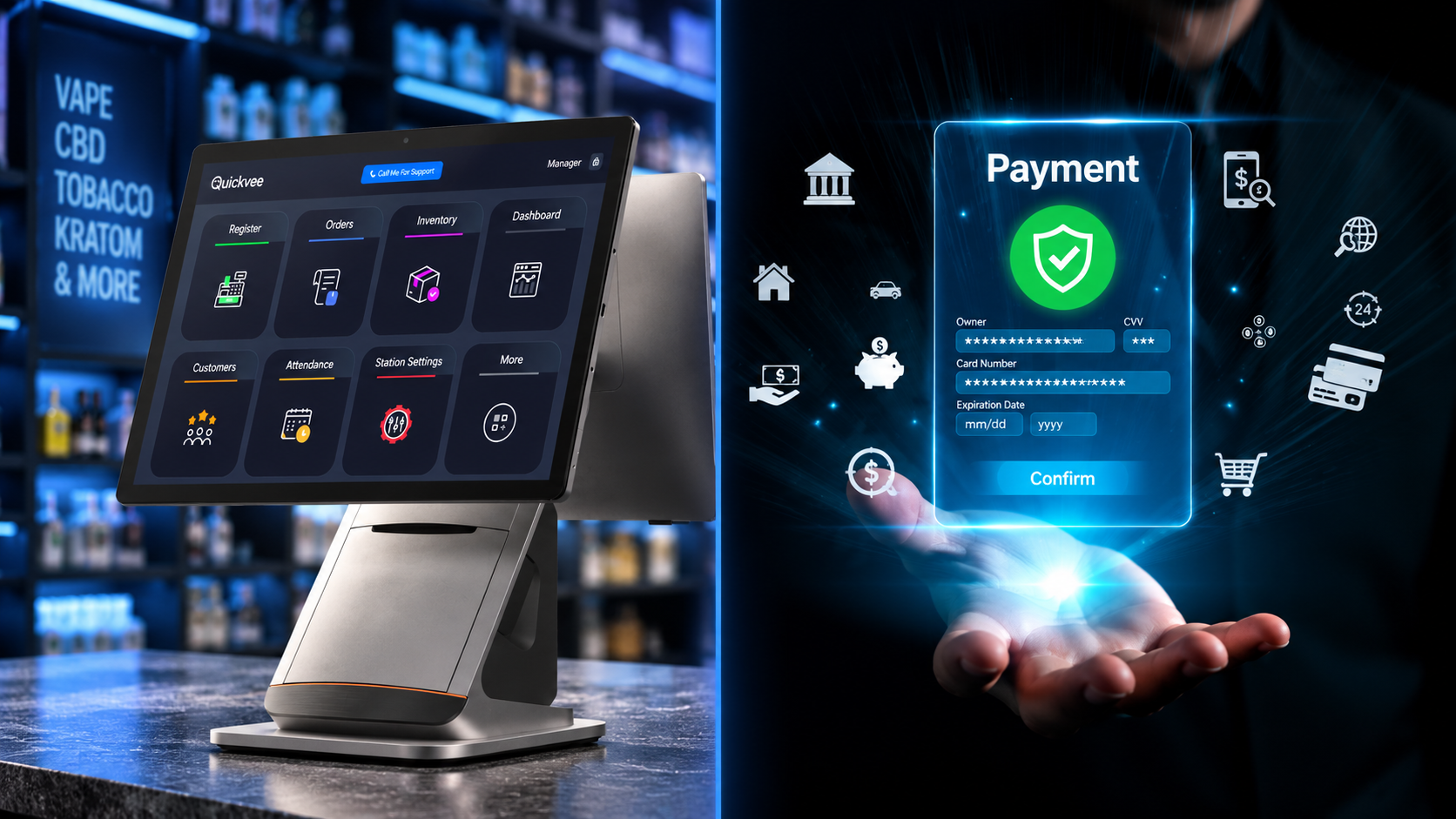
CBD POS Software is the software that boosts your store—from inventory to checkout to compliance to reporting to online sales. CBD payment processing is the financial system that really transfers funds from your customer’s card to your bank account.
A CBD retailer needs both, but they solve different problems, come from different types of providers, and fail in different ways when set up wrong.
This guide breaks down exactly what each one does, why CBD sits in a uniquely difficult category for payments, and how to decide whether you need two separate vendors or one system that handles both — including how Quickvee approaches this for age-restricted and high-risk retailers.
What is CBD POS Software?
CBD POS software acts as the operating system for your vape or smoke shop. It is the platform your staff uses to manage day-to-day store operations and other activities as shown below.
- Inventory management — Tracking CBD tinctures, edibles, topicals, and vape products by SKU, batch, or COA (Certificate of Analysis)
- Compliance tools — Audit logs, age-verification prompts, and ID scanning for age-restricted products.
- Sales and checkout — Barcode scanning, discounts, bundles, and receipt printing
- Online ordering — Ecommerce integration, pickup and delivery
- Reporting — Check sales trends, best-sellers, employee performance, and tax reporting
- Customer engagement — Loyalty programs, rewards points, and repeat-purchase tracking
A CBD POS system does not, by itself, move money. It’s the software layer that records the sale and tells the payment system how much to charge.
What is CBD Payment Processing?
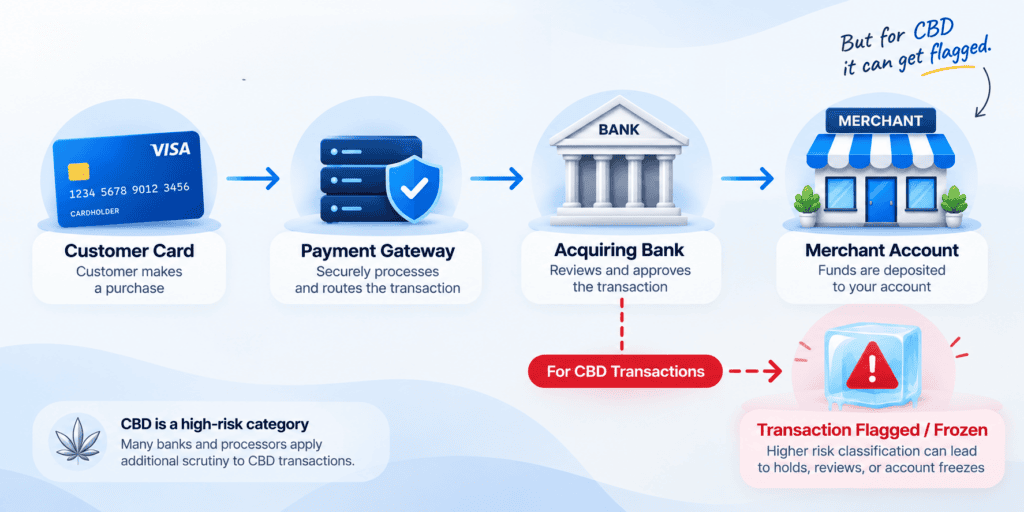
CBD payment processing is the financial pipeline that authorizes a transaction, moves funds from the customer’s bank to a processor, and eventually deposits that money into the merchant’s business bank account. This involves:
- A merchant account — The account that holds funds before they settle into your bank
- A payment gateway — The technology that encrypts and transmits card data
- An acquiring bank — The financial institution that underwrites the merchant and accepts the risk
- Card networks — Visa, Mastercard, Discover, Amex, which route the transaction
For most retail categories, this process is invisible and automatic — Square, Stripe, or a bank handles it without much scrutiny. CBD is different.
Why CBD Payment Processing is Classified as High-Risk
- Regulatory Ambiguity — The FDA still restricts certain marketing and health claims, and state-level rules vary widely, so processors can’t apply one clean rulebook.
- Elevated chargeback Rates — CBD carries higher dispute rates than typical retail categories, which increases risk exposure for banks.
- Reputational Caution — Mainstream processors like Stripe, Square, and PayPal generally avoid categories associated with cannabis, even when the product itself is fully compliant hemp-derived CBD.
- Card network restrictions — Visa and Mastercard apply extra underwriting requirements to CBD merchant codes.
The practical result: mainstream aggregators either reject CBD merchants outright or approve them under a blanket policy then freeze funds the moment their automated systems flag a CBD-related transaction. This is why CBD merchants specifically need a dedicated high-risk merchant account, not a standard processor.
CBD POS Software vs CBD Payment Processing:
| CBD POS Software | CBD Payment Processing | |
|---|---|---|
| What It Does | Runs the store: inventory, checkout, compliance, reporting | Moves money: authorization, settlement, funding |
| Who Provides It | POS/retail software companies | High-risk merchant account providers, acquiring banks |
| Compliance Role | Age verification, audit logs, product tracking | Chargeback management, underwriting documentation |
| Risk Classification | Not classified as high-risk itself | Classified high-risk due to card network rules |
| Failure Mode If Wrong | Poor inventory accuracy, compliance gaps, clunky checkout | Frozen funds, terminated account, Match list flags |
| Typical Cost Structure | Monthly software fee (or $0 in some models) | Per-transaction processing rate, often 4–8% for high-risk CBD |
Do CBD Merchants Need Both?
Yes – Every CBD retailer requires a cbd pos system and a payment processing setup.
Option A: Separate vendors. You select a POS system and a high risk payment processor separately, and then connect them. This allows for flexibility in processor changes without affecting POS, but implies the need for two vendor relationships, two vendor support lines, and the possibility of an integration failure during a processor change.
Option B: An all-in-one system with built-in high-risk processing. The POS vendor has already solved the high-risk merchant account problem and bundles it in. This removes the integration risk and the guesswork of vetting a separate processor, but it does mean less flexibility to shop processors independently.
Neither option is universally “correct” — it depends on transaction volume, whether you also sell tobacco/vape/kratom products alongside CBD, and how much time you want to spend managing vendors versus running your store.
How Quickvee Approaches CBD POS and Payments Together
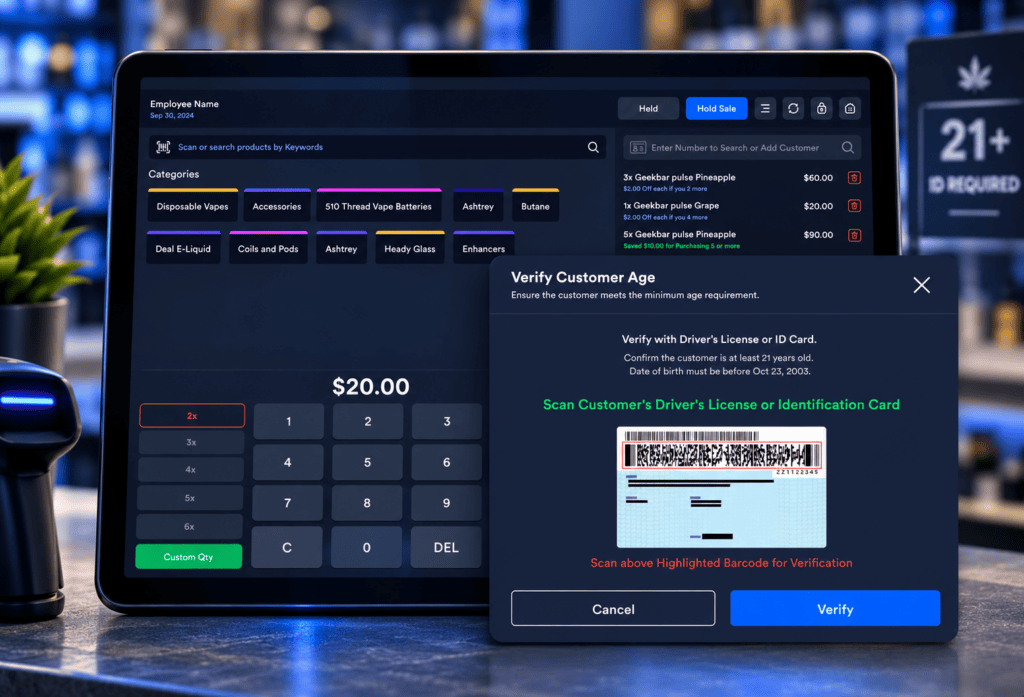
Quickvee was built specifically for age-restricted and high-risk retail — smoke shops, vape stores, tobacco retailers, and stores carrying CBD, delta-8, and kratom. Rather than treating payments as a bolt-on integration, Quickvee includes high-risk payment processing built directly into the POS, so CBD merchants don’t have to separately shop, apply for, and integrate a third-party high-risk merchant account.
What that looks like in practice for a CBD retailer on Quickvee:
- Native high-risk processing capability for CBD, delta-8, and tobacco-adjacent products, so that a sale doesn’t get rejected or marked at checkout as it would on a mainstream processor, like Square or Stripe.
- PCI-compliant, encrypted transactions across EMV chip, NFC/contactless, and major card networks, with next-day funding.
- Mandatory age verification at checkout — required for most CBD and hemp-derived product sales in many states — logged automatically for audit purposes.
- Age-gated online ordering, so pickup and delivery orders for CBD products require ID verification before checkout, not just in-store.
- Real-time inventory tracking down to batch and SKU level, which matters for CBD products where COA and potency tracking affect compliance.
- Compliance audit logs that document every age check and verification attempt, which matters if a regulator or card network ever reviews the account.
- One dashboard for sales, inventory, employee permissions, and payments — instead of reconciling data between a separate POS and a separate processor’s portal.
The core idea: for a CBD merchant, the POS and the payment processor aren’t really separate problems — a checkout that can’t process the payment isn’t a functioning checkout at all. Quickvee’s model treats compliance and payment approval as part of the same system, rather than something the merchant has to stitch together after the fact.
Choosing the Right Setup for Your CBD Store
A Few Questions to Check Before Proceeding with the Setup
- Are CBD and other regulated products (e.g. vape, tobacco, delta-8, kratom) available together? If you do, then a unified system will minimize the amount of compliance tools you’re dealing with.
- What’s your monthly processing volume? Under roughly $20,000/month, simpler processors may work; above that, dedicated high-risk underwriting becomes more valuable for predictability.
- Have you already been declined or frozen by Stripe, Square, or PayPal? That’s a strong signal you need a specialist high-risk account rather than another mainstream aggregator.
- How much internal bandwidth do you have to manage vendors? A combined POS-and-processing system reduces the number of relationships you have to maintain, at the cost of some flexibility to negotiate processing rates independently.
FAQs
No. POS software runs your store's operations — inventory, checkout, compliance, reporting. A payment processor is the financial infrastructure that authorizes and settles the transaction. Many CBD retailers use POS systems, like Quickvee, that include high-risk payment processing built in, but the two functions are technically distinct.
Because CBD carries regulatory ambiguity, higher chargeback rates, and card network restrictions, mainstream processors like Stripe, Square, and PayPal typically decline or later freeze CBD merchant accounts. A dedicated high-risk merchant account is underwritten specifically for CBD, making approval and payouts far more predictable.
Funds are typically held as a chargeback reserve, sometimes for 90–180 days, and there's often no meaningful appeal process with mainstream aggregators. A dedicated high-risk merchant account, with individual underwriting, is designed specifically to avoid this outcome.
Yes. Quickvee includes high-risk payment processing for CBD, delta-8, and tobacco-adjacent products directly within its POS system, alongside built-in age verification, compliance audit logs, and real-time inventory tracking.
Hemp-derived CBD containing less than 0.3% THC is federally legal under the 2018 Farm Bill. However, state-level rules vary, and the FDA still regulates marketing and labeling claims, which is part of why CBD payments remain classified as high-risk.
Recent Blogs
Is THC Banned in 2026? State-by-State Guide for Retailers
August 24, 2026
Square CBD Shutdown: What Hemp and CBD Merchants Need to Do Now
August 11, 2026
Delta 8 vs Delta 9 vs THCA: 2026 Smoke Shop Guide
July 16, 2026
How to Increase Smoke Shop Sales with Online Ordering
June 10, 2026